
Metal Roofing vs. Spray Foam Roofing: Which Is Right for Your Property?
When it is time to repair or replace your roof, the material you choose can affect much more than how your property looks from the street. It can influence how well your property stays insulated, how you deal with future repairs, and what kind of maintenance you take on over the years.
For property owners in Weaverville, two options worth comparing are metal roofing and spray foam roof insulation. Metal is known for its strong, durable surface, while spray foam takes a different approach by combining roofing protection with continuous insulation.
So, how do you know which one fits your property better? The answer becomes much clearer once you understand what each system does well, where it may fall short, and what your existing roof actually needs. So, let’s look at how they compare and where each option works best.
Metal Roofing vs. Spray Foam Roofing: What’s the Main Difference?
The main difference between metal roofing and spray foam roofing is that metal roofing uses panels or sheets to create a durable exterior roof, but spray polyurethane foam roofing creates a continuous layer that provides roofing and insulation together.
- Metal Roofing: A metal roof can be extremely durable, but metal panels alone do not provide the insulation needed to control heat transfer. So, if you choose metal roofing, you will also need to consider the right insulation for the roof assembly.
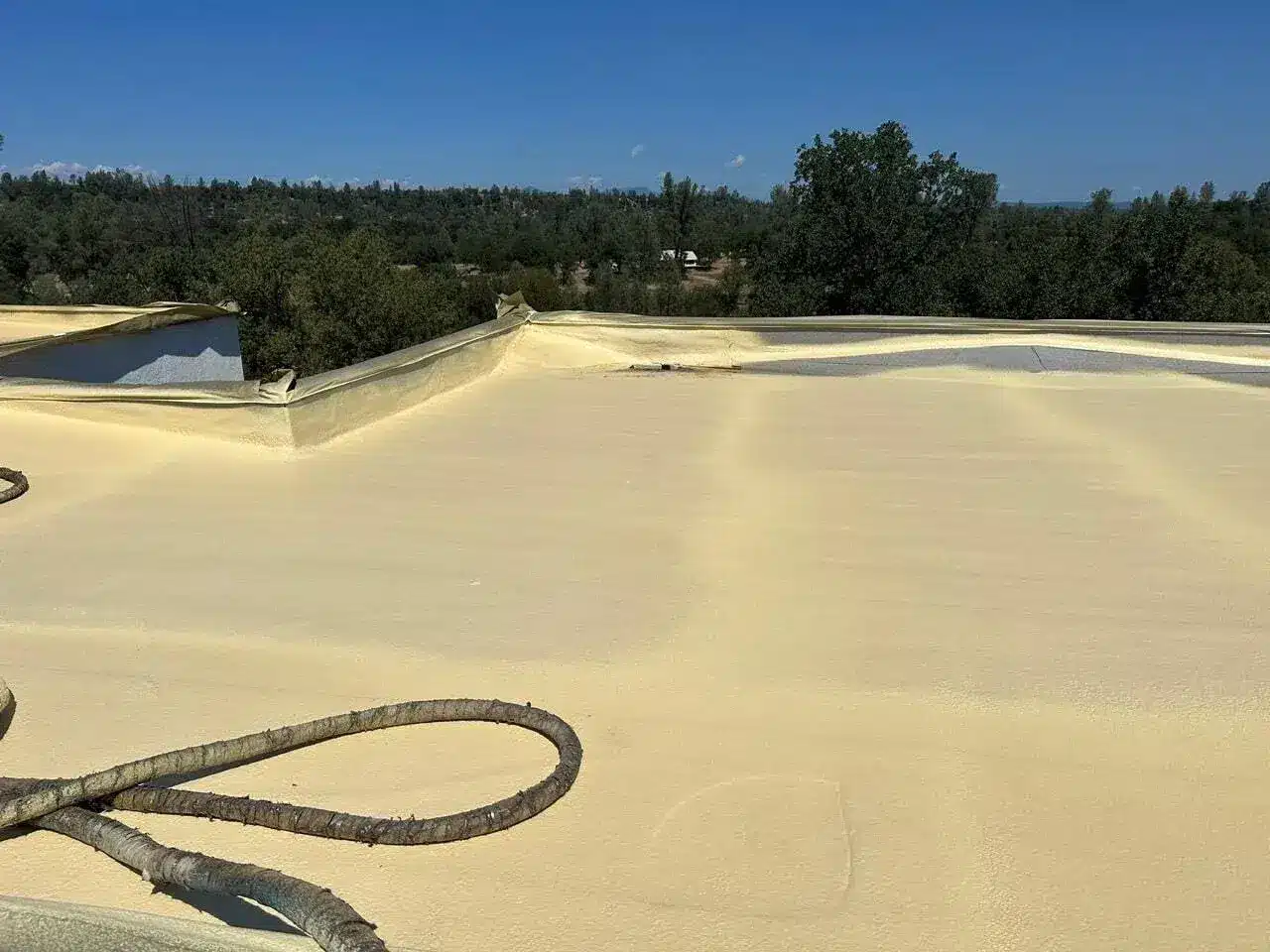
- Spray Foam Roofing: With spray polyurethane foam roofing, two liquid components – an isocyanate and a polyol resin blend – are mixed and sprayed directly onto the prepared roof surface. They react and expand to form a continuous foam layer that provides insulation and roofing protection. An elastomeric protective coating is then applied over the foam, helping protect it from UV exposure, weather, and everyday wear.
Here’s a more detailed comparison of the two –
| Factors | Metal Roofing | Spray Foam Roofing |
| Basic construction | Metal panels or sheets | Seamless, sprayed-in-place foam |
| Insulation | Usually requires a separate insulation strategy | Provides continuous insulation as part of the system |
| Seams | Panels have joints, seams, and fasteners depending on the system | Seamless application |
| Roof penetrations | Requires careful flashing | Foam can conform around penetrations |
| Weight | Varies by metal system | Lightweight |
| Existing roof | May require more extensive preparation or removal depending on conditions | Can often be applied over suitable existing roofing |
| Maintenance | Inspections, fasteners/seams, coatings depending on system | Inspections, localized repairs, and eventual recoating |
| Best fit | Owners prioritizing a traditional, durable roof | Owners prioritizing insulation, air sealing, and seamless coverage |
| Get Your Free Roofing Estimate – Call Us At (530) 275-4588 |
Why Does Weaverville’s Climate Matter When Choosing a Roof?
Weaverville’s seasonal changes bring different challenges for your roof. Hot, dry summers make heat control important, while colder, wetter conditions mean the roof also needs reliable protection from the elements. So, when choosing between metal and spray foam, it helps to look at how each system handles these demands.
- A reflective metal roof can reduce the amount of solar energy it absorbs. The U.S. Department of Energy notes that roofing products with high solar reflectance can reduce building cooling loads, with the greatest savings generally occurring in hot climates. However, insulation is still a separate consideration with a metal roofing system.
- Spray foam roof insulation takes a different approach. SPF creates a continuous layer of thermal insulation while also sealing gaps where air leakage could occur.
So, if you are comparing metal and foam roofing, consider more than the roofing surface itself. The way the complete system manages heat, insulation, and weather protection can help you decide which option better fits your property.
When Does Metal Roofing Make More Sense?
Metal roofing may be the better choice when you want a traditional roofing system with a long-lasting exterior surface. It can make sense if –
- You are already planning a complete roof replacement.
- You prefer the appearance of metal panels.
- Your building can accommodate the selected metal roofing assembly.
- You have already planned an effective insulation system.
- You are comfortable maintaining seams, flashing, fasteners, and other vulnerable areas as required by the particular system.
There is another important point here. A metal roof can still be part of an energy-efficient property. For example, choosing a reflective or “cool” metal roof can reduce solar heat absorption. But if insulation is a priority, the metal panels are only part of the equation. You also need to consider the insulation beneath them.
When Does Spray Foam Roofing Make More Sense?
Spray foam roofing can be particularly useful when you want to improve the roof while adding continuous insulation and sealing at the same time.
Imagine an older commercial building with several vents, pipes, HVAC curbs, and other roof penetrations. Here, every transition can give water and air another place to find their way through if the roof system is not properly sealed. SPF approaches that problem differently. Because the material is sprayed in place, it follows the shape of the roof and forms a continuous surface around many penetrations and irregular areas.
Also, SPF is not simply foam sprayed onto a roof and left exposed. The completed system includes a protective covering, such as an elastomeric roof coating, to protect the foam from UV exposure and weathering.
Can You Use Spray Foam Insulation With a Metal Roof?
Yes. You don’t always have to choose between metal and foam. SPF insulation can also be used as part of a properly designed metal-roof assembly.
Metal roofing alone provides limited resistance to heat flow, which is why proper insulation is an important part of a metal-roof assembly. Depending on how the roof is designed, SPF insulation can be incorporated into the assembly to create a continuous thermal barrier, reduce heat transfer, and seal gaps where air leakage may occur.
However, foam insulation should be planned around the metal roof you already have. Before recommending an application, a professional should evaluate –
- How your roof is built: The existing metal panels and what sits underneath them.
- Where the foam will go: The best place to apply it based on the way your roof is constructed.
- Any moisture problems: Signs of leaks, trapped moisture, or condensation that should be dealt with first.
- How the roof breathes: Whether adding foam will change the ventilation the roof currently relies on.
- Roof condition: Whether damaged or deteriorated areas require repair before insulation is installed.
This is why an inspection should come before a product recommendation. Once a professional understands how your metal roof is built and its current condition, they can determine whether spray foam is appropriate and how it should be incorporated into the system.
Can Spray Foam Roofing Work for Mobile Homes and Commercial Properties?
Yes. Because SPF is lightweight and applied as a continuous layer, it can work with different roof types, including mobile homes and commercial properties. How it compares with metal, however, depends on the roof you are working with.
- For mobile home roofing, SPF can add roofing protection and insulation without installing a new metal panel system.
Metal roofing provides a durable exterior surface but usually requires insulation to be addressed separately.
- For commercial roofing, SPF can conform around HVAC units, vents, pipes, drains, and other penetrations to create a continuous insulated surface.
A metal roof can also work well for commercial properties, but its panels, seams, flashing, and penetrations require proper detailing during installation.
For either property type, the existing roof should be inspected first. Its condition and design can help determine whether metal or SPF is the more practical choice.
| See If SPF Insulation Is Right for Your Roof – Call (530) 275-4588 |
Common Questions About Metal and Spray Foam Roofing
1. Which Is More Expensive, Metal Roofing or Spray Foam Roofing?
Costs depend on the roof size, condition, design, and preparation required. Metal roofing costs can also depend on panel type and installation complexity. And SPF pricing usually depends on foam thickness, roof preparation, and coating requirements. If you need an exact quote, start with a professional roof inspection rather than relying on a general per-square-foot estimate.
2. Is Spray Foam Roofing Better than Metal Roofing?
There isn’t one right choice for every property. Metal roofing gives you a strong, long-lasting roof surface, while spray foam adds roofing protection and insulation in one continuous system. The better fit comes down to your existing roof, how much insulation you need, your budget, and what you want from the roof over the years.
3. How Often Should a Spray Foam Roof Be Maintained?
A spray foam roof should generally be inspected twice a year and after severe weather. Small damage should be repaired promptly, while the protective coating may need periodic renewal. With proper inspections, maintenance, and recoating, an SPF roof can work properly for 40 years or more.
Conclusion: Which Roof Should You Choose for Your Weaverville Property?
Choose the roofing system that best fits your property and its needs.
- If you want the appearance and durability of a traditional panel system and are prepared to address insulation separately, a metal roof may be an excellent fit.
- If your bigger concerns are heat, insulation, air leakage, complicated roof penetrations, or restoring a suitable existing roof, spray foam roofing deserves serious consideration.
And sometimes the smartest solution involves both metal and foam. The important part is getting the roof inspected first. Its condition, existing materials, insulation needs, and how you use the property all influence what makes sense for your property.
Choose the Right Roof With Confidence With Foam Experts Co.
Your roof protects your home, your business, and everything you have invested in the property. So, when you are choosing between metal and foam roofing in Weaverville, CA, you want more than a quick recommendation. You want to know why a roofing system makes sense for your particular roof.
Making that decision is easier when you have decades of roofing experience behind the recommendation. Foam Experts Co. has served Northern California since 1983, giving our team more than 40 years of experience helping property owners understand what their roofs need. As a family-owned and locally operated company, our team is licensed (CSLB License #455066), bonded, and insured, and is a member of the Spray Polyurethane Foam Alliance (SPFA).
Whether you need commercial roofing in Weaverville, CA, mobile home roofing, or long-lasting foam insulation in Weaverville, CA, we can inspect your roof, explain what we find, and help you choose a solution with confidence. Call Foam Experts Co. for a free estimate at (530) 275-4588.